Hidden Allergens in Japanese Cuisine: Dashi, Soba, Sesame and More
Published: 2026-07-23 ・ Last updated: 2026-08-07
The trickiest allergens in Japanese food are the ones you never see on the plate: the stock in the soup, the flour in the batter, the oil in the dressing.
Why the label may not save you
Two facts explain most of this. Restaurants in Japan have no legal duty to provide allergen information — labeling rules apply only to prepackaged foods, as the Consumer Affairs Agency (CAA) explains in its consumer materials. And even on packaged food, only nine allergens are mandatory as of April 2026, while 20 more — including sesame and salmon — are merely recommended and can be present without being declared. Several staples of Japanese cooking sit exactly in those gaps. For the framework, see Japanese allergen labeling basics and eating out in Japan with food allergies.
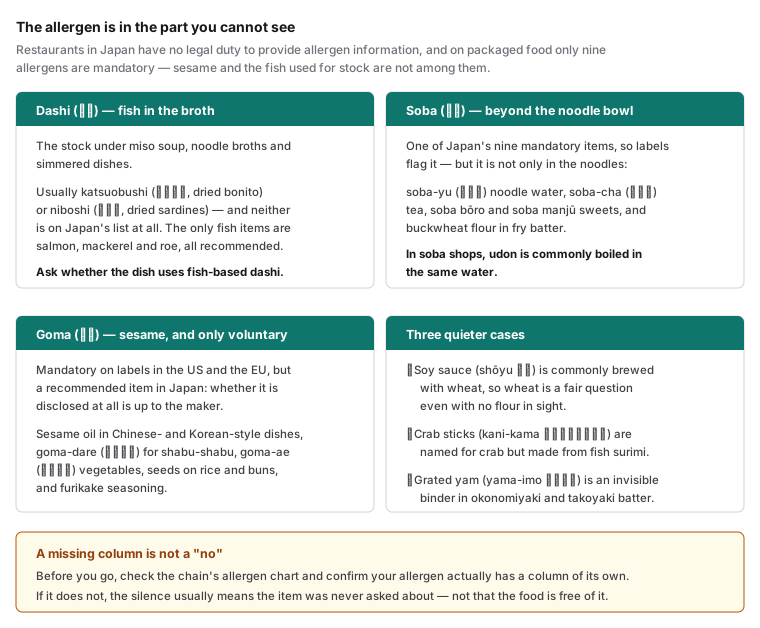
Fish is in the broth — and mostly off the list
Dashi (出汁), the stock under miso soup, noodle broths, and simmered dishes, is typically made from katsuobushi (かつお節, dried bonito flakes) or niboshi (煮干し, dried small sardines). Yet Japan's allergen list has no general fish category: the only fish items are salmon (sake さけ — fish sold as サーモン counts too), mackerel (saba さば), and salmon roe (ikura いくら) — all recommended, not mandatory. Bonito and sardine are not covered at all: in the handbook's example of a noodle-soup base (tsuyu つゆ), katsuobushi and niboshi appear among the flavor ingredients, but only the mackerel flakes trigger an allergen mention. If you avoid fish, assume a Japanese-style soup or sauce may be built on fish stock, and ask whether it uses fish-based dashi. Some menus use kombu (昆布, kelp) or shiitake stock instead — whether that works for you is for your doctor to say.
Buckwheat reaches beyond the noodle bowl
Buckwheat (soba そば) is one of Japan's nine mandatory items — the CAA notes it can cause severe reactions — yet it is absent from the US and EU mandatory lists. It appears in more than noodles: soba-yu (そば湯), the noodle-boiling water served as a drink to mix into leftover dipping sauce; soba-cha (そば茶), roasted buckwheat tea that is sometimes the complimentary tea; sweets such as soba bōro cookies and soba manjū buns; and even batters — one handbook example labels fried chicken for buckwheat flour in the coating. In soba restaurants, udon and soba are commonly boiled in the same water, and the CAA's eating-out pamphlet lists airborne buckwheat flour as a contamination route — so ordering udon there is not automatically the safe move.
Sesame is everywhere, and only voluntary
Sesame (goma ごま) is mandatory on labels in the US and the EU, but in Japan it is a recommended item — disclosure is up to the maker. Meanwhile it is among Japan's most widely used flavorings: sesame oil in Chinese- and Korean-style dishes, goma-dare (ごまだれ) dipping sauce for shabu-shabu, goma-ae (ごま和え) dressed vegetables, and seeds on rice, buns, and furikake seasoning. On an allergen chart, check whether sesame has a column at all: a missing column means no information, not sesame-free.
Soy sauce, crab sticks, and grated yam
Three quieter cases. Soy sauce (shōyu 醤油) is commonly brewed with wheat — the handbook's examples show it declared as containing both wheat and soybeans — so wheat is a fair question even with no flour in sight. Crab sticks (kani-kama かに風味かまぼこ) are named for crab but made from fish: the handbook's example lists whitefish surimi as the main ingredient, alongside egg white, wheat starch, crab extract, and shrimp-derived flavoring. And grated yam (yama-imo やまいも), a recommended-tier item, is often an invisible binder in okonomiyaki and takoyaki batter.
What to ask, in practice
- Before you go, check the chain's allergen chart and confirm your allergen actually has a column. Our search page links to official allergen information for chains across Japan.
- Ask about the invisible parts, not just the dish: the stock, the sauce, the oil, the batter, the boiling water. Phrases and card tactics are in communicating allergies at Japanese restaurants.
- When answers are vague, choose another dish or another restaurant. Cross-contact can never be fully ruled out, and what is safe for you personally is a decision to make with your doctor.
When you want a meal you can verify entirely from the label, convenience stores are the most label-reliable option.
If an allergen on your home country's mandatory list is missing from a Japanese chart, that silence usually means the item was never on the question sheet — not that it is absent. Which items that applies to, per region, is set out in how to read our allergen data.
The rules here reflect official materials as of July 2026. Recipes vary shop by shop — treat this as a checklist of questions, and get the answers at the restaurant, on the day.
References
This article is for general information purposes and is not medical advice. While we strive for accuracy, regulations and company disclosures may change. Always check the latest official information from the restaurant before eating.