An Allergy Card in Japanese: Phrases That Actually Work
Published: 2026-07-24 ・ Last updated: 2026-09-20
An allergy card is a short text in Japanese — printed, or saved as a note or image on your phone — that states what you are allergic to and how serious it is. For a visitor who does not speak Japanese, it is the single most effective tool at a restaurant. This article gives you the exact sentences and vocabulary to build one; for spoken phrases and table tactics, see our guide to communicating allergies at Japanese restaurants.
Why written Japanese beats spoken English
Three reasons. First, the person you meet is rarely the person who decides: floor staff carry your question to the kitchen, and a card travels there word-for-word, while a spoken English sentence often does not survive the relay. Second, katakana loanwords are traps — "arerugī" (アレルギー) is understood, but many allergen names are not obvious from English pronunciation. Third, written Japanese removes doubt about severity: a card can state plainly that this is a medical condition, not a preference, which changes how carefully the kitchen responds.
One expectation to set: restaurants in Japan are not legally required to provide allergen information, so a card is a communication aid, not a guarantee — the kitchen may still answer "we cannot be sure." Our guide to eating out in Japan with food allergies covers how to plan around that.
What the card should contain
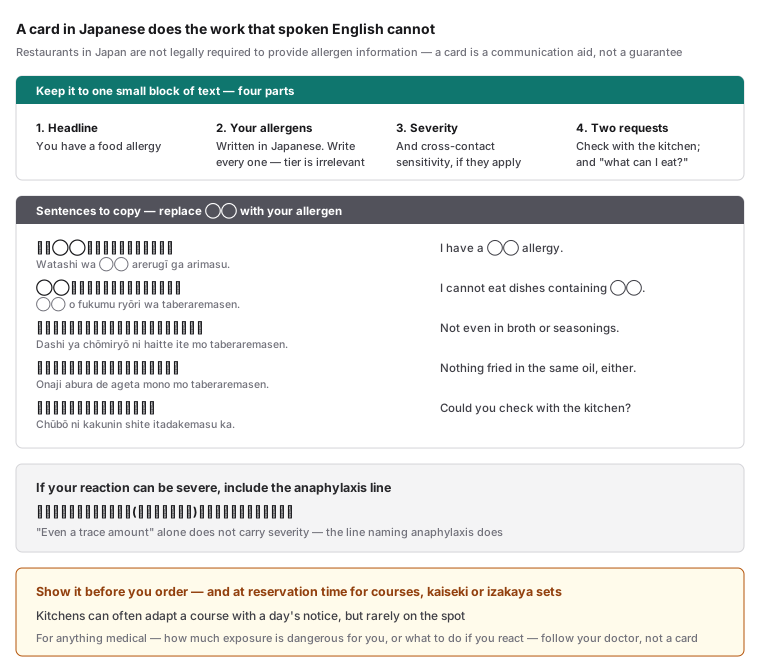
Keep it to one small block of text:
- A headline: you have a food allergy.
- Your allergens, written in Japanese (list below).
- Severity and cross-contact sensitivity, if they apply to you.
- A request to check with the kitchen, and a fallback question ("what can I eat?").
Allergen vocabulary for the card
Use the same words that appear on Japanese food labels. As of July 2026, Japan mandates labeling of nine allergens on packaged foods — cashew nuts became the ninth on April 1, 2026, with a two-year transition period, so older packaging may still follow the 8-item list until spring 2028. Twenty more items, including pistachio (added in 2026), are recommended-only. On your card, the legal tier does not matter — write every allergen you have.
| English | Japanese | Reading |
|---|---|---|
| Egg | 卵 | tamago |
| Milk / dairy | 乳・牛乳 | nyū / gyūnyū |
| Wheat | 小麦 | komugi |
| Buckwheat | そば | soba |
| Peanut | 落花生(ピーナッツ) | rakkasei (pīnattsu) |
| Shrimp | えび | ebi |
| Crab | かに | kani |
| Walnut | くるみ | kurumi |
| Cashew | カシューナッツ | kashū nattsu |
| Pistachio | ピスタチオ | pisutachio |
| Sesame | ごま | goma |
| Soy | 大豆 | daizu |
| Fish | 魚 | sakana |
| Tree nuts (general) | ナッツ類 | nattsu-rui |
If your allergen is not listed here, check the label vocabulary in Japan's allergen labeling basics or ask a Japanese speaker to write it for you before your trip.
Sentences that actually work
Copy the ones that fit your situation, replacing ◯◯ with your allergen from the table above. Together they make a complete card.
Where the table above gives two words for one allergen (乳・牛乳, 落花生(ピーナッツ)), pick one — pasting both reads oddly in a sentence.
If your reaction can be severe, include the anaphylaxis line. Written Japanese is what tells a kitchen this is a medical condition rather than a preference, and "even a trace amount" alone does not carry that. The line naming anaphylaxis does.
| Japanese | Reading | Meaning |
|---|---|---|
| 私は食物アレルギーがあります。 | Watashi wa shokumotsu arerugī ga arimasu. | I have food allergies. |
| 私は◯◯アレルギーがあります。 | Watashi wa ◯◯ arerugī ga arimasu. | I have a ◯◯ allergy. |
| ◯◯を含む料理は食べられません。 | ◯◯ o fukumu ryōri wa taberaremasen. | I cannot eat dishes containing ◯◯. |
| 微量でも症状が出ます。 | Biryō demo shōjō ga demasu. | Even a trace amount causes a reaction. |
| 少量でもアナフィラキシー(命に関わる症状)を起こすことがあります。 | Shōryō demo anafirakishī (inochi ni kakawaru shōjō) o okosu koto ga arimasu. | Even a small amount can cause anaphylaxis — a life-threatening reaction. |
| 同じ油で揚げたものも食べられません。 | Onaji abura de ageta mono mo taberaremasen. | I also cannot eat anything fried in the same oil. |
| だしや調味料に入っていても食べられません。 | Dashi ya chōmiryō ni haitte ite mo taberaremasen. | I cannot have it even in broth or seasonings. |
| 調理器具の共有でも反応することがあります。 | Chōri kigu no kyōyū demo hannō suru koto ga arimasu. | I can react even to shared cooking equipment. |
| 厨房に確認していただけますか。 | Chūbō ni kakunin shite itadakemasu ka. | Could you check with the kitchen? |
| 食べられるメニューを教えていただけますか。 | Taberareru menyū o oshiete itadakemasu ka. | Could you tell me which dishes I can eat? |
The broth and cross-contact lines matter more in Japan than elsewhere: dashi (だし) stock, soy sauce, and shared fryers put allergens into dishes that look unrelated — our guide to hidden allergens in Japanese cuisine explains where.
An official sheet you can point at
Japan's Consumer Affairs Agency publishes a free English Food Allergy Communication Sheet: a bilingual pictogram chart where you tick your allergens and show it to staff, with a preprinted line reading 私は食物アレルギーです ("I have food allergies") and a question asking whether the food contains the marked items. Save it to your phone before you travel. One caveat: as of July 2026 the English edition still groups allergens under the pre-2026 lists — "8 specified ingredients" plus 20 others, with cashew in the second group — which does not affect its usefulness as a pointing tool.
Show it at the right moment
Timing does most of the work. Show the card before you order, not after the food arrives. For course meals, kaiseki, or izakaya set menus, present it at reservation time so staff can check ingredients, preparation and whether any changes are possible. Do not assume the kitchen can adapt the meal. You can look up published allergen information before you go to prepare your questions, but still confirm the details with the restaurant before ordering. For anything medical — how much exposure is dangerous for you, or what to do if you react — follow your doctor's advice, not a card.
References
- Consumer Affairs Agency of Japan, Food Allergy Communication Sheet (English)
- Consumer Affairs Agency of Japan, information page on food allergen labelling (in Japanese)
- Consumer Affairs Agency of Japan, Food Labelling Division notice on labelling of foods containing allergens, April 1, 2026 (in Japanese)
This article is for general information purposes and is not medical advice. While we strive for accuracy, regulations and company disclosures may change. Always check the latest official information from the restaurant before eating.