"Vegan" Is Not "Allergen-Free": What Plant-Based Labels Mean in Japan
Published: 2026-07-24 ・ Last updated: 2026-08-18
A vegan icon on a menu answers one question: does this contain animal products? An allergy is a different question — and in Japan the two are handled by entirely different systems. Filtering for "vegan" as a shortcut to "safe for my allergy" fails in both directions.
Two systems, only one of them a law
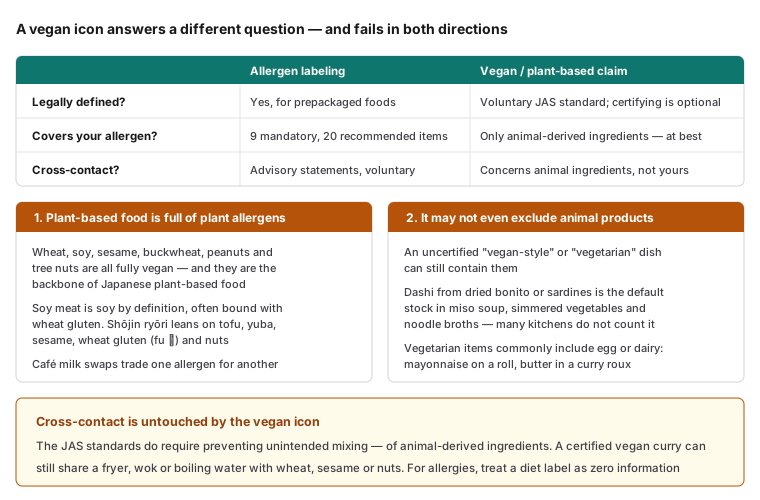
Allergen labeling in Japan is a legal regime for prepackaged foods, run by the Consumer Affairs Agency (CAA): as of July 2026 it covers 9 mandatory items (cashew joined the mandatory list on April 1, 2026) plus 20 recommended ones. How it works — and where it stops — is covered in Japanese allergen labeling basics.
Vegan and vegetarian claims sit outside that regime. Japan has Japanese Agricultural Standards (JAS) for "processed foods suitable for vegetarians or vegans" and for restaurants serving such dishes, but JAS certification is voluntary — a business can print "vegan" or "plant-based (プラントベース)" without it, constrained mainly by general rules against misleading representations. The CAA's own plant-based leaflet and Q&A urge consumers with food allergies to read the actual ingredient list rather than rely on a plant-derived product name.
| Question | Allergen labeling | Vegan / plant-based claim |
|---|---|---|
| Legally defined? | Yes, for prepackaged foods | Voluntary JAS standard; certification optional |
| Covers your allergen? | 9 mandatory, 20 recommended items | Only animal-derived ingredients, at best |
| Cross-contact addressed? | Advisory statements, voluntary | Concerns animal ingredients, not your allergen |
Plant-based food is full of plant allergens
The first failure mode is simple: most allergens in Japanese cooking are plants. Wheat, soy, sesame, buckwheat (soba そば), peanuts, and tree nuts are all fully vegan — and they are the backbone of Japanese plant-based food.
- Soy meat (daizu mīto 大豆ミート) is soy by definition and often bound with wheat gluten; seitan-style mock meats are essentially pure wheat.
- Shōjin ryōri (精進料理), Buddhist temple cuisine, is plant-based by design yet leans heavily on tofu, yuba, sesame (goma-dōfu ごま豆腐 is a signature dish), wheat gluten (fu 麩), and nuts.
- Café milk swaps trade one allergen for another: oat drinks bring gluten questions, almond and cashew drinks are a direct problem for tree-nut allergies.
A vegan menu is, if anything, denser in these ingredients than a standard one.
"Vegetable" dishes that are not what they seem
The second failure mode: an uncertified "vegan-style" or "vegetarian" dish may not even exclude animal products. Dashi (だし) made from dried bonito or sardines is the default stock in miso soup, simmered vegetables, and noodle broths, and many kitchens do not think of it as "meat or fish." Vegetarian items also commonly include egg or dairy — mayonnaise on a vegetable roll, butter in a curry roux. For people with fish, egg, or milk allergies, this is exactly the trap described in hidden allergens in Japanese cuisine: the allergen is in the stock or the sauce, not on the plate.
And cross-contact is untouched by the vegan icon. The JAS standards do require preventing unintended mixing — of animal-derived ingredients. A certified vegan curry can still share a fryer, wok, or boiling water with wheat, sesame, or nuts, and the CAA treats facility cross-contact statements on packages as voluntary advisories.
Use allergen information, not diet labels
- On packaged food, read the allergen declaration and ingredient list, not the front-of-pack diet claim.
- At restaurants, ask about your specific allergen and name the invisible parts — the dashi, the sauce, the batter. Phrasings are in communicating allergies at Japanese restaurants.
- Prefer chains that publish per-menu allergen charts, and check that your allergen has its own column. Our search page links to official allergen information for chains across Japan.
Vegan labels are useful for what they were built for. For allergies, treat them as zero information — and go get the per-allergen answer instead.
References
- Consumer Affairs Agency of Japan, food allergen labeling portal (in Japanese)
- Consumer Affairs Agency of Japan, plant-based food information page with leaflet and labeling Q&A (in Japanese)
- Ministry of Agriculture, Forestry and Fisheries, overview of the JAS standards for processed foods and restaurants suitable for vegetarians or vegans (in Japanese)
This article is for general information purposes and is not medical advice. While we strive for accuracy, regulations and company disclosures may change. Always check the latest official information from the restaurant before eating.