Convenience Stores in Japan: The Most Label-Reliable Way to Eat with Allergies
Published: 2026-07-23 ・ Last updated: 2026-08-18
Eating out in Japan with a food allergy usually means negotiating: asking staff, decoding menus, trusting a kitchen you cannot see. The convenience store — konbini (コンビニ) — flips that. Nearly everything on its shelves is a sealed, packaged processed food, which under Japanese law must carry allergen labeling. That makes the konbini one of the few places in Japan where you can verify a meal entirely by yourself, in writing. Here is how to use that — and where the label's protection ends.
Why the konbini shelf works in your favor
Japan's mandatory allergen labeling applies to processed foods sold in container packaging — exactly what fills a convenience store: rice balls (onigiri, おにぎり), sandwiches (サンドイッチ, sandoicchi), boxed meals (bentō, 弁当), packaged salads, breads, and snacks. Every one of these must declare the nine mandatory allergens when present: egg, milk, wheat, buckwheat, peanuts, shrimp, crab, walnut, and cashew (added April 2026). The full table with Japanese script is in our guide to Japan's allergen labeling system.
Two details make this stricter than it sounds: even on packages too small for full labeling (a printable area of 30 cm² or less), allergen information can never be omitted; and a label, unlike a verbal answer, involves no language barrier or guesswork. If communicating your allergy at restaurants feels risky on a given day, the konbini is the fallback that is always open.
The ten-second label scan
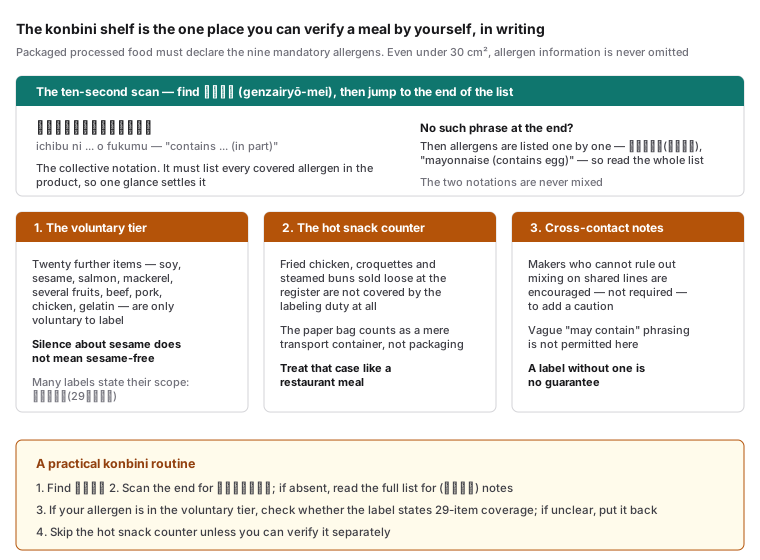
Find the ingredient list, headed 原材料名 (genzairyō-mei). Then jump straight to its end and look for a parenthesized phrase:
(一部に〇〇・〇〇を含む) — ichibu ni ... o fukumu, "contains ... (in part)".
This is the collective notation. When a label uses it, the phrase must list every covered allergen in the product, so one glance settles it. It is common on bento and other multi-ingredient items, and may even be printed on the front of a bento where it is easier to spot.
The two notations are never mixed: no 一部に〜を含む phrase at the end means the label lists allergens individually — マヨネーズ(卵を含む), "mayonnaise (contains egg)" — so read the whole list. A schematic tuna-mayonnaise onigiri label looks like: rice, seasoned tuna flakes, mayonnaise, nori, ...(一部に卵・小麦・大豆を含む)— contains egg, wheat, and soy.
Three gaps the label will not close
1. Recommended-tier allergens may go unmentioned. Twenty further items — including soy, sesame, salmon, mackerel, several fruits, beef, pork, chicken, and gelatin — are only voluntary to label. A label that is silent about sesame does not tell you the product is sesame-free. Many labels state their scope near the allergen line — アレルゲン(29品目対象), "allergens, 29 items covered" — a practice the CAA recommends. And during the cashew transition period, older stock labeled under the previous 8-item rules is still legally on shelves.
2. The hot snack counter is a different legal world. Fried chicken, croquettes, and steamed buns sold loose at the register and handed over in a paper bag are not covered by the labeling duty. Food prepared or processed on site and sold without container packaging is explicitly outside the rules, and the bag or box used to carry it home counts as a mere transport container, not packaging. Any allergen information here is voluntary — treat the hot-snack case like a restaurant meal (see eating out in Japan with food allergies).
3. Cross-contact notes are advisory, and their absence proves little. Manufacturers who cannot rule out unintended mixing on shared lines are encouraged to add a caution such as 本品製造工場では〇〇を含む製品を生産しています — "this factory also produces products containing ...". Vague "may contain" phrasing is not permitted, but the caution itself is not mandatory, so a label without one is no guarantee. Whether trace-level exposure matters for you is a question for your doctor, not for a label.
A practical konbini routine
- Pick up the item and find 原材料名.
- Scan the end of the list for 一部に〜を含む; if absent, read the full list for (〜を含む) notes.
- If your allergen is in the recommended tier, check whether the label states 29-item coverage; if unclear, put it back or check the manufacturer's website.
- Skip the hot snack counter unless you can verify it separately.
For restaurant chains rather than shelves, our allergen search links to official allergen disclosures across Japan. And before you head out to eat, know where allergens hide in Japanese cuisine.
References
This article is for general information purposes and is not medical advice. While we strive for accuracy, regulations and company disclosures may change. Always check the latest official information from the restaurant before eating.