Japan's Allergen Labeling System: What the 9+20 Items Mean for Visitors
Published: 2026-07-23 ・ Last updated: 2026-08-07
Understanding the labeling system
If you are visiting or living in Japan with a food allergy, the labeling system is both better and trickier than many people expect: better, because mandatory allergen labeling is strictly enforced on packaged foods; trickier, because the list of covered allergens is not the one you know from home. Here is how the system works, based on the official materials of the Consumer Affairs Agency (CAA), Japan's food-labeling authority, as of July 2026.
Two tiers: 9 mandatory items and 20 recommended items
Japanese law requires allergen labeling for nine "specified ingredients" (tokutei genzairyō). A revision effective April 1, 2026 added cashew nuts as the ninth item. Knowing the Japanese script for these nine helps you pattern-match labels in a shop:
| Allergen | On the label | Reading |
|---|---|---|
| Egg | 卵 | tamago |
| Milk | 乳 | nyū |
| Wheat | 小麦 | komugi |
| Buckwheat | そば | soba |
| Peanuts | 落花生(ピーナッツ) | rakkasei (pīnattsu) |
| Shrimp | えび | ebi |
| Crab | かに | kani |
| Walnuts | くるみ | kurumi |
| Cashew nuts | カシューナッツ | kashū nattsu |
A further 20 items are only recommended for labeling: almond, abalone, squid, salmon roe, orange, kiwi fruit, beef, sesame, salmon, mackerel, soybean, chicken, banana, pistachio, pork, macadamia nuts, peach, yam, apple, and gelatin. Recommended means voluntary — many manufacturers label them, but nothing forces them to.
One transition-period caveat: the cashew requirement comes with a two-year grace period, so until the end of March 2028 products labeled under the old 8-item rules are still legally on shelves.
Your home country's list is not Japan's list
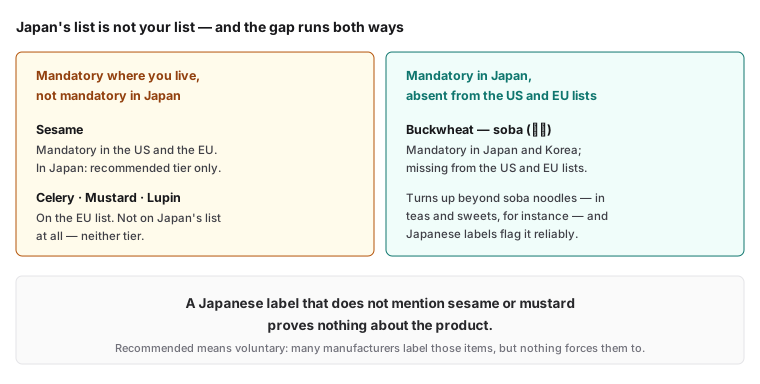
This is the single most important point for travelers. Items that are mandatory where you live may be merely voluntary — or entirely absent — here. Sesame is mandatory in the United States and the European Union but only recommended in Japan; celery, mustard, and lupin from the EU list do not appear on Japan's list at all. A Japanese label that does not mention sesame or mustard proves nothing about the product.
The reverse also applies: buckwheat is a mandatory allergen in Japan (and Korea) even though it is missing from the US and EU lists. It shows up not only in soba noodles but in places you might not expect, such as teas and sweets — and Japanese labels will reliably flag it.
Labels are only required on prepackaged processed foods
The labeling duty covers packaged processed foods and additives — the sealed items you buy in supermarkets and convenience stores. It does not cover food served in restaurants or delivered meals, nor loose, bakery, or deli items sold unpackaged. Any allergen information in those settings is voluntary. See our guide to eating out in Japan with food allergies for how to navigate that side.
How the allergen line looks on a label
Japanese labels use two formats. Individual notation, the default, puts the allergen in parentheses right after each ingredient: マヨネーズ(卵を含む) means "mayonnaise (contains egg)"; milk appears as 乳成分 in this phrasing. Collective notation gathers every covered allergen in the product into one phrase at the end of the ingredient list: (一部に卵・乳成分を含む) means "contains egg and milk (in part)".
That final (一部に〜を含む) phrase is the quickest thing to scan — when present, it must list all covered allergens in the product. If there is no such phrase, the label uses individual notation, and you need to read the whole ingredient list; note that recognized synonyms such as 玉子 or エッグ for egg can stand in without a "contains" note.
Practical tips
- On packaged food, scan the end of the ingredient list first for 一部に〜を含む.
- On menus and chain allergen charts, look for a row or column labeled アレルゲン (allergen). Major chains publish detailed charts; our chain search links to official allergen information for chains across Japan. Those charts follow Japan's list, so on a chain or restaurant page you can pick the labeling standard for your own region and see which Japanese columns can answer for it — and which of your items have no column at all. The full mapping is in how to read our allergen data.
- The CAA publishes an English Food Allergy Communication Sheet with pictograms you can point at — handy, though the April 2024 version still shows the pre-2026 list of 8 mandatory items.
- When a recommended-tier allergen matters to you, treat an unlabeled product as unverified and check with the manufacturer, and talk to your doctor about what precautions fit your situation.
For phrases and tactics at the table, continue to communicating allergies at Japanese restaurants.
References
- Consumer Affairs Agency of Japan, information page on food allergen labelling (in Japanese)
- Consumer Affairs Agency of Japan, Food Allergen Labelling Handbook, April 2026 edition (in Japanese)
- Consumer Affairs Agency of Japan, Food Labelling Division notice on labelling of foods containing allergens, April 1, 2026 (in Japanese)
- Consumer Affairs Agency of Japan, Food Allergy Communication Sheet (English)
This article is for general information purposes and is not medical advice. While we strive for accuracy, regulations and company disclosures may change. Always check the latest official information from the restaurant before eating.