Eating Out in Japan with Food Allergies: A Practical Guide
Published: 2026-07-23 ・ Last updated: 2026-08-07
A food allergy does not have to keep you from enjoying Japan's food scene — but the system here works differently from what many visitors and residents expect. Here is the one rule that shapes everything, and a practical routine built around it.
Restaurants have no legal duty to provide allergen information
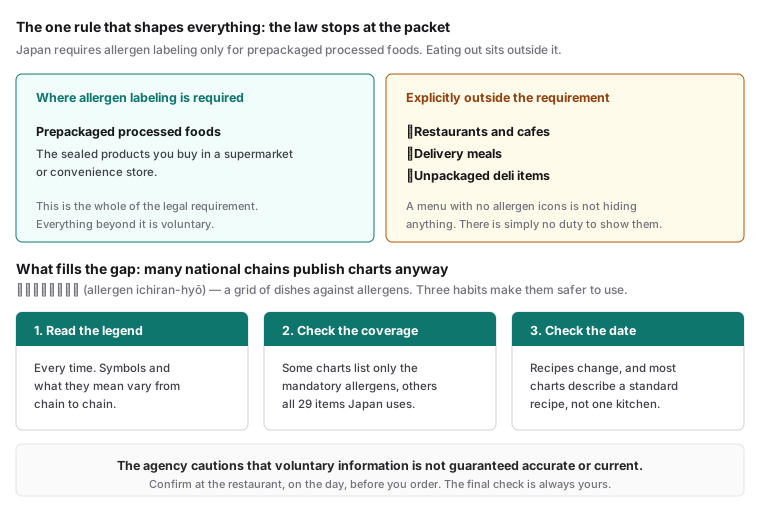
Japan's rules require allergen labeling only for prepackaged processed foods — the sealed products you buy in a supermarket or convenience store. Food served in restaurants and cafes, delivery meals, and unpackaged deli items are explicitly outside the requirement, as the Consumer Affairs Agency (the national food-labeling authority) explains in its official materials. A menu with no allergen icons is not hiding anything; there is simply no legal obligation to show them. The flip side: whatever information a restaurant does provide is voluntary, and the agency cautions that it is not guaranteed to be accurate or current. The final check is always yours.
The good news: major chains publish allergen charts
Japan has a strong culture of voluntary disclosure. Many national chains post menu-by-menu allergen charts — called アレルゲン一覧表 (allergen ichiran-hyō) — on their websites: a grid of dishes against allergens, with symbols marking what each dish contains. Three habits make them safer to use:
- Read the legend every time. Symbols and their meanings vary from chain to chain.
- Check the coverage. Some charts list only the mandatory allergens, others all 29 items used in Japanese labeling.
- Check the date. Recipes change, and most charts describe standard recipes, not conditions in each kitchen.
Japan's allergen list is not your country's list
As of April 2026, nine allergens are mandatory on packaged food labels: egg, milk, wheat, buckwheat, peanuts, shrimp, crab, walnuts, and cashew nuts. Another 20 items — including sesame, soy, almonds, and macadamia nuts — are only recommended, so a label or chart may simply omit them. Note that sesame is mandatory in many other jurisdictions but not in Japan, and celery and mustard are not on the Japanese list at all — so no sesame mark does not mean sesame-free. Japan also covers allergens rare elsewhere, such as buckwheat, which appears not only in soba noodles but also in teas and sweets. For the full picture, see Japanese allergen labeling basics.
A practical routine for eating out
- Research before you go. Our English search page lists chains in Japan with links to their official allergen information.
- Communicate clearly. Say you have a food allergy and ask someone knowledgeable, such as a manager. The person taking your order is usually not the cook, so a written note or allergy card helps — phrases and tactics are in communicating allergies at Japanese restaurants.
- Watch for cross-contact. Shared fryers, cutting boards, tongs, and airborne flour can carry allergens into dishes whose recipes are free of them. Ask whether utensils can be separated; unintended contamination can never be fully ruled out in a restaurant kitchen.
- Carry your medication, and follow your doctor's guidance on what is safe for you to eat. When you cannot get a clear answer, choosing another restaurant beats guessing.
The rules described here reflect official materials as of July 2026. Treat anything you read online as a starting point — confirm at the restaurant, on the day, before you order.
References
- Consumer Affairs Agency of Japan, Food Allergen Labelling Handbook, April 2026 edition (in Japanese)
- Consumer Affairs Agency of Japan, consumer pamphlet on eating out and takeout with food allergies (in Japanese)
- Consumer Affairs Agency of Japan, information page on food allergen labelling (in Japanese)
This article is for general information purposes and is not medical advice. While we strive for accuracy, regulations and company disclosures may change. Always check the latest official information from the restaurant before eating.