If You Have a Reaction in Japan: Emergency Basics for Visitors
Published: 2026-07-24 ・ Last updated: 2026-08-18
Knowing how Japan's emergency system works takes stress out of traveling with a food allergy. This article covers logistics only — numbers, language support, hospitals, insurance, paperwork. It is not medical guidance; decisions about your medication belong with your doctor before you travel and with the emergency professionals on the day.
Calling 119: how the ambulance system works
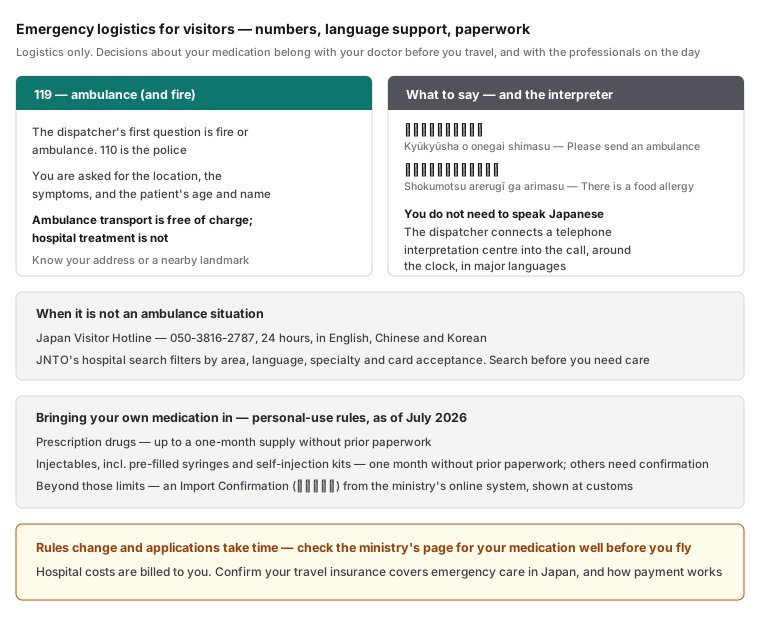
The emergency number for an ambulance is 119. It also covers fire — the dispatcher's first question is fire or ambulance — and it differs from 110, the police. Per the Fire and Disaster Management Agency's visitor guide, the dispatcher then asks for the location, the symptoms, and the patient's age and name. Ambulance transport is free of charge; hospital treatment is not, which is why travel insurance matters (more below).
The word for ambulance is kyūkyūsha (救急車). Useful phrases:
| Japanese | Romaji | Meaning |
|---|---|---|
| 救急車をお願いします | Kyūkyūsha o onegai shimasu | Please send an ambulance |
| アレルギーです | Arerugī desu | It is an allergy |
| 食物アレルギーがあります | Shokumotsu arerugī ga arimasu | There is a food allergy |
Know your address or a nearby landmark — hotel key cards usually show one.
Language support on the 119 line
You do not need to speak Japanese to call 119. The Fire and Disaster Management Agency promotes a three-party interpretation system: the dispatcher connects a telephone interpretation center into the call, so you, the dispatcher, and an interpreter speak together. It operates around the clock in major languages, and as of January 2025 it covered 673 of Japan's 720 fire departments — most, though not all, of the country. Stay on the line; the dispatcher manages the connection.
When it is not an ambulance situation
For help that does not require a 119 call, the Japan National Tourism Organization (JNTO) runs two services for visitors:
- The Japan Visitor Hotline, 050-3816-2787, answers 24 hours a day in English, Chinese, and Korean for emergencies such as illness and for general tourist questions.
- JNTO's online hospital search filters clinics by area, language, specialty, and credit-card acceptance, and can prioritize 24-hour facilities. Institutions handling foreign languages are limited, so search before you need care.
Hospital costs are billed to you as a visitor. Confirm before departure that your travel insurance covers emergency treatment and how payment works (cashless versus reimbursement); JNTO notes some policies can even be bought after arrival.
Bringing your own medication into Japan
Japan regulates the import of medicines, including those in your luggage. As of July 2026, the Ministry of Health, Labour and Welfare (MHLW) rules for personal use are, in outline:
- Prescription drugs: up to a one-month supply without prior paperwork.
- Injectables: pre-filled syringes and self-injection kits — the category that includes epinephrine auto-injectors — up to a one-month supply without prior paperwork; other injectables need an Import Confirmation.
- Other (non-prescription) drugs and quasi-drugs: up to a two-month supply.
- Beyond these limits you need an Import Confirmation, called Yunyu Kakunin-shō (輸入確認証, formerly Yakkan Shōmei), obtained from MHLW's online system before departure and shown at customs.
- Narcotics and stimulant raw materials are strictly restricted; some drugs legal at home are prohibited.
Rules change and applications take time — check the MHLW page for your medication well before you fly, and ask your doctor what to carry and for documentation such as a prescription copy.
Before you travel: a logistics checklist
- Consult your doctor about your medication plan for the trip, and carry documentation for it.
- Verify the MHLW import rules for each medicine, and apply for an Import Confirmation if needed.
- Confirm your travel insurance covers emergency care in Japan, and save the claims contact.
- Save 119 and 050-3816-2787, note your hotel's address in Japanese, and bookmark JNTO's hospital search.
- Prevention matters most: research chains on our search page, learn the system in eating out in Japan with food allergies, and prepare phrases and cards with communicating allergies at Japanese restaurants and our ready-made allergy card in Japanese.
The details above reflect official sources as of July 2026 — confirm current rules on the linked pages before you travel.
References
- Fire and Disaster Management Agency, Guide for Ambulance Services (English pamphlet)
- Fire and Disaster Management Agency, three-party simultaneous interpretation for 119 calls (in Japanese)
- Japan National Tourism Organization, Guide for when you are feeling ill
- Ministry of Health, Labour and Welfare, Information for those who are bringing medicines for personal use into Japan
This article is for general information purposes and is not medical advice. While we strive for accuracy, regulations and company disclosures may change. Always check the latest official information from the restaurant before eating.