Visiting Japan's Theme Parks with Food Allergies: Disney and USJ
Published: 2026-08-01 ・ Last updated: 2026-08-18
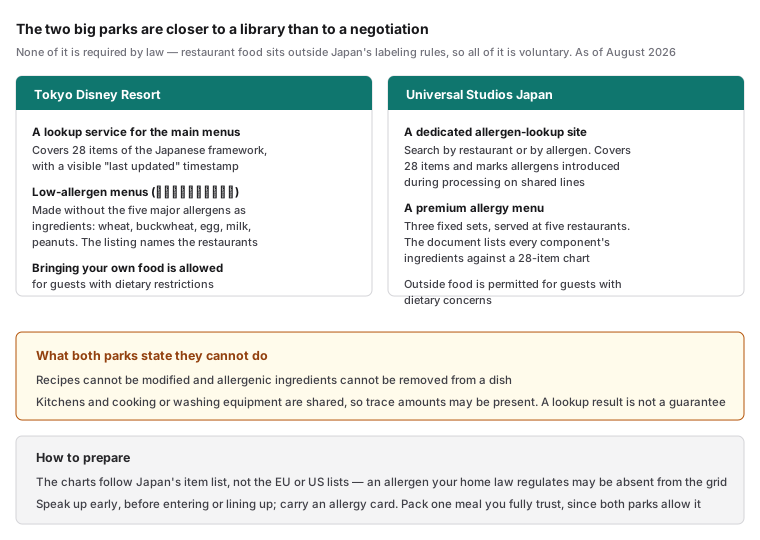
If ordinary restaurants in Japan are a negotiation, the two big theme parks are closer to a library. Tokyo Disney Resort and Universal Studios Japan (USJ) both publish allergen information for their food, offer dedicated low-allergen dishes, and — unusually for Japan — explicitly allow allergic guests to bring their own food. None of this is required by law: restaurant food sits entirely outside Japan's allergen labeling rules, so everything below is voluntary disclosure that each park controls and can change (see how Japan's labeling system works). Details here are as of August 2026; re-check the official pages before your trip.
Tokyo Disney Resort
As of August 2026, the resort's official allergen information service for Tokyo Disneyland and Tokyo DisneySea states:
- Allergen charts for the main menus are published through a lookup service covering 28 items of the Japanese labeling framework, with a visible "last updated" timestamp. Note the edition: the page still lists 8 mandatory items, with cashew among the 20 recommended ones — the pre-April-2026 grouping.
- Low-allergen menus (teiarerugen menyū 低アレルゲンメニュー) are dishes made without the "five major allergens" (godai arerugen 5大アレルゲン) as ingredients: wheat, buckwheat (soba そば), egg, milk, and peanuts. The listing names the serving restaurants — from counter-service curry at Hungry Bear Restaurant to a low-allergen course at Blue Bayou — with prices, and asks guests to allow extra serving time.
- Bringing your own food into park restaurants is explicitly allowed for guests with dietary restrictions; the resort asks that accompanying members order from the restaurant's menu.
- The resort states it cannot change menus or remove allergenic ingredients from dishes, that kitchens and cooking or washing equipment are shared with other menus so trace amounts may be present, and that lookup results are no guarantee against a reaction — the final judgment rests with the guest.
Our Tokyo Disney Resort page keeps those official pages together with notes on what each one covers and how it is organised. It does not reproduce the charts: the resort publishes them through a lookup service it updates itself, so the page sends you there rather than showing you a copy.
Universal Studios Japan
USJ runs a dedicated allergen-lookup site where you can search by restaurant or by allergen. It covers 28 items of the Japanese labeling framework and marks allergens including those introduced during processing on shared lines. The site's own caveats: it cannot guarantee a reaction-free meal, recipes cannot be modified, and you should confirm with staff on the day because menus change.
Beyond the chart, USJ offers a premium allergy menu (as of the March 2026 edition): three fixed sets — steamed sea bream, hamburg steak, and teriyaki chicken, each with soup, rice, dessert, and juice — served at five restaurants including Park Side Grille, Kinopio's Café, SAIDO, Lombard's Landing, and Studio Stars Restaurant. The published document lists every component's ingredients against a 28-item chart (the pre-April-2026 edition of Japan's list, which still groups cashew with the voluntary items), and asks guests to allow extra time because the dishes are prepared with special care. Select restaurants also carry simpler low-allergen menus, and the park permits bringing outside food for guests with dietary concerns. Our Universal Studios Japan page does the same job for the lookup site and the premium menu document — where each one starts, what it covers, and where it stops.
How to prepare
- Before the trip, read the parks' charts the way you would any Japanese chain chart: they follow Japan's item list, not the EU or US lists, so an allergen your home country regulates may be absent from the grid entirely — check the item-by-item differences first. Note that as of August 2026 charts may still follow the older 28-item edition, listing cashew in the voluntary tier even though it became mandatory on packaged food in April 2026.
- On the day, the parks' process assumes you speak up early — before entering or lining up. Staff are used to the request, but the conversation happens in Japanese more often than not; carry an allergy card with ready-made phrases.
- Pack a fallback. Since both parks allow it for allergic guests, bringing one meal you fully trust removes the worst-case scenario.
The caveats that still apply
The parks are the best-documented dining environment most allergic visitors will meet in Japan, but the fundamentals do not change: charts describe recipes, not your plate; kitchens are shared; menus rotate seasonally and pages move. Treat every figure above as a snapshot and confirm on the official sites — and for the chains you will eat at outside the parks, you can check disclosed allergen information by chain before you go.
References
- Tokyo Disney Resort, restaurant allergen information service, notice and terms (in Japanese)
- Tokyo Disney Resort, low-allergen menu listing, Tokyo Disneyland (in Japanese)
- Universal Studios Japan, Allergen information search site (in Japanese)
- Universal Studios Japan, Premium allergy menu details, updated March 3, 2026 (in Japanese)
- Consumer Affairs Agency of Japan, food allergen labelling overview page (in Japanese)
This article is for general information purposes and is not medical advice. While we strive for accuracy, regulations and company disclosures may change. Always check the latest official information from the restaurant before eating.