Japan's Allergen List vs. the US and EU Lists: What Changes When You Land
Published: 2026-08-01 ・ Last updated: 2026-08-18
Understanding the labeling system
If you manage a food allergy under EU or US rules, you have spent years training an instinct: scan the label or the menu for a short list of emphasized allergens, and trust that the law made someone check. That instinct still works in Japan — but it is calibrated to the wrong list. Japan's labeling law names different allergens, splits them into a mandatory and a voluntary tier, and does not apply to restaurant food at all. This article maps the differences item by item, based on the official texts as of August 2026. For how Japan's system works on its own terms, see Japan's allergen labeling system.
Three laws, three lists
- Japan requires 9 items on packaged food, called tokutei genzairyō (特定原材料): egg, milk, wheat, buckwheat, peanuts, shrimp, crab, walnut, and — since April 2026 — cashew. A further 20 items are recommended only: producers are encouraged, not obliged, to label them.
- The EU requires 14 substances (Annex II of Regulation 1169/2011): the familiar core plus celery, mustard, lupin, sulphites, molluscs, sesame, and soy — and the information duty extends to restaurant food.
- The US requires 9 major food allergens on packaged food (FALCPA, plus sesame since January 2023): milk, egg, fish, crustacean shellfish, tree nuts, peanuts, wheat, soy, sesame.
The overlap is real — egg, milk, wheat, peanuts, and crustaceans are mandatory everywhere. Everything else moves.
Allergens Japan's list never asks about
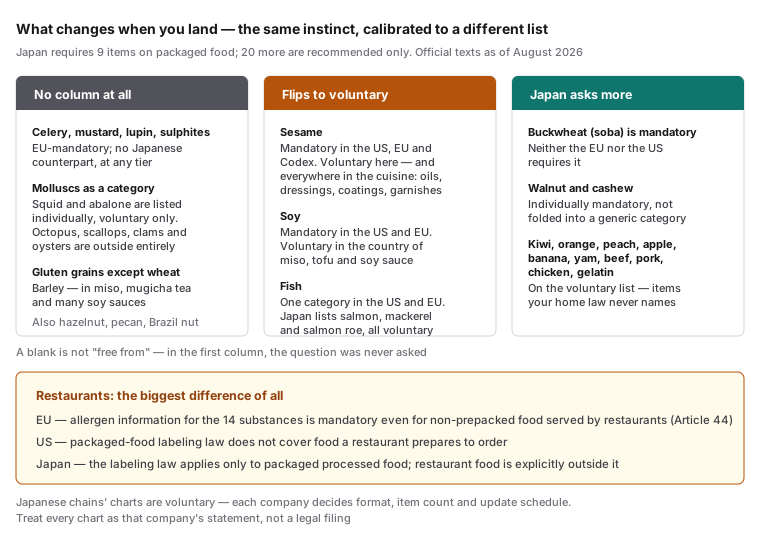
For these, a Japanese allergen chart has no column at all. A blank is not "free from" — the question was never asked.
- Celery, mustard, lupin, sulphites (EU-mandatory) have no Japanese counterpart, mandatory or voluntary. Celery and mustard hide in stocks, sauces and spice mixes here just as they do in Europe; nothing on a Japanese label or chart will flag them.
- Molluscs as a category does not exist. Japan lists squid and abalone individually — and only as voluntary items. Octopus, scallops, clams and oysters, all common in Japanese cooking, are outside the system entirely.
- Gluten grains other than wheat. The EU's "cereals containing gluten" covers wheat, rye, barley and oats; Japan's mandatory item is wheat alone. Barley (in miso, mugicha barley tea, and many soy sauces) is not separately labeled.
- Most tree nut species. Japan names each nut individually instead of using a "tree nuts" category: walnut and cashew are mandatory; almond, macadamia and pistachio are voluntary. Hazelnut, pecan, Brazil nut and pine nut — all on the EU's list of 8 named nuts or the FDA's list of 12 — appear nowhere in Japan's 29 items.
Allergens that flip from mandatory to voluntary
These are on Japan's list, but in the voluntary tier — so a given chart or label may cover them, or may silently omit them.
- Sesame is mandatory in the US, the EU, and the international Codex standard. In Japan it is voluntary, and sesame is everywhere in the cuisine: oils, dressings, coatings, garnishes.
- Soy is mandatory in the US and the EU, voluntary in Japan — in the country of miso, tofu and soy sauce.
- Fish is a single mandatory category in the US and the EU ("fish and products thereof"). Japan instead lists salmon, mackerel and salmon roe as three separate voluntary items. No Japanese column answers for cod, tuna, sea bream, or the fish-based dashi stock that underlies much of the cuisine.
Where Japan asks more than your home law
The differences run both ways, and some work in your favor.
- Buckwheat (soba) is mandatory — a reflection of how present it is in noodles, tea and sweets here, and how serious reactions to it can be. Neither the EU nor the US requires it.
- Walnut and cashew are individually mandatory, not folded into a generic nut category, so Japanese charts answer for them by name.
- Kiwi, orange, peach, apple, banana, yam, beef, pork, chicken and gelatin are on the voluntary list — items your home law never names. When a chart does cover the voluntary tier, you get answers the EU or US label never gave you.
Restaurants: the biggest difference of all
In the EU, allergen information for the 14 substances is mandatory even for non-prepacked food served by restaurants and caterers (Article 44 of Regulation 1169/2011). In the US, packaged-food labeling law does not cover food a restaurant prepares to order. Japan is at the far end of that spectrum: the labeling law applies only to packaged processed food, and food served in restaurants is explicitly outside it. The allergen charts that Japanese chains publish are voluntary — often detailed and well maintained, but each company decides its own format, item count and update schedule. Treat every chart as that company's statement, not a legal filing, and confirm the current situation with the restaurant itself. Our guide to reading Japanese allergen charts covers the symbols and fine print.
For context: the international Codex standard, which national laws use as a reference point, was revised in 2024 into the same two-tier shape Japan uses — a core list every country should require (which now includes sesame) and a second tier left to regional judgment. Lists keep moving; the differences above are a snapshot, not a constant.
Checking a Japanese chain against your home list
On this site, every chain and restaurant page lets you pick the labeling standard of your region and select allergens from that list. The page then tells you, for each selection, whether the chain's Japanese-format information can answer for it — fully, only in part (EU "fish" maps onto Japan's salmon, mackerel and salmon-roe columns and nothing else), or not at all (celery, mustard, lupin, sulphites). The exact mapping for every EU, US and Codex item is listed in how our allergen data works, and you can start from the chain search.
References
- Consumer Affairs Agency of Japan, information page on food allergen labelling (in Japanese)
- Consumer Affairs Agency of Japan, Food Allergen Labelling Handbook, April 2026 edition (in Japanese)
- Regulation (EU) No 1169/2011 on the provision of food information to consumers, consolidated text (EUR-Lex)
- Regulation (EU) No 1169/2011, Annex II and Article 44 full text (UK statute database copy)
- United States Code, 21 U.S.C. § 321(qq), definition of major food allergen (Cornell LII)
- FDA, Questions and Answers Regarding Food Allergens, Edition 5, January 2025 (regulations.gov docket copy)
- WHO, 47th session of the FAO/WHO Codex Alimentarius Commission adopts new standards, November 2024
This article is for general information purposes and is not medical advice. While we strive for accuracy, regulations and company disclosures may change. Always check the latest official information from the restaurant before eating.