Gluten-Free in Japan Is Not the Same as Wheat-Allergy Safe
Published: 2026-08-01 ・ Last updated: 2026-08-18
If you searched "gluten free Japan", you are probably in one of two different situations: you have celiac disease (or another gluten-related condition) and need to avoid gluten from wheat, barley, and rye down to trace levels — or you have a wheat allergy and need to avoid wheat as an ingredient. Japan's labeling system serves these two groups very differently, and knowing which question a Japanese label actually answers will save you real confusion.
Japan declares wheat, not gluten
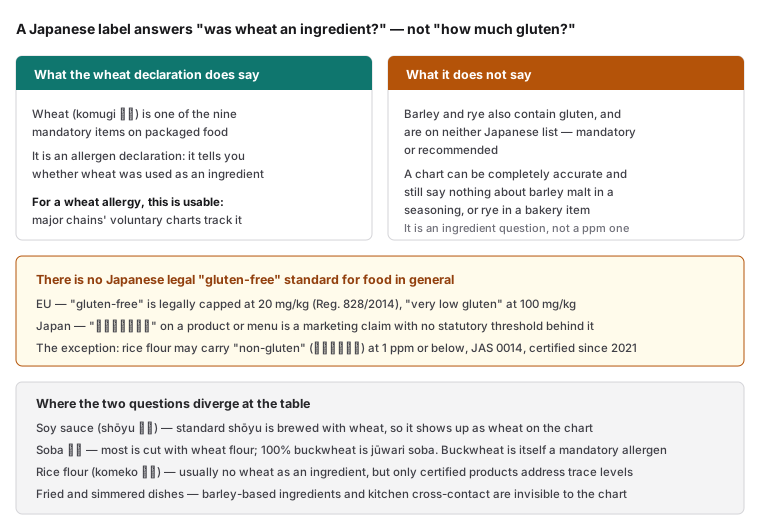
Japan's mandatory allergen list — nine items on packaged food, per the Consumer Affairs Agency (CAA) — includes wheat (komugi 小麦). It is an allergen declaration: it tells you whether wheat was used as an ingredient. It is not a gluten declaration. Barley and rye, which also contain gluten, are not on Japan's mandatory list, nor on the 20-item recommended list. A Japanese label or a restaurant chain's allergen chart (ichiranhyō) can be completely accurate and still say nothing about barley malt in a seasoning or rye in a bakery item.
Two more caveats carry over from the general system, explained in our guide to Japan's labeling basics: restaurant food is outside the labeling law entirely, so chain allergen charts are voluntary; and those charts answer an ingredient question, not a parts-per-million question. A "no wheat" mark tells you wheat was not a listed ingredient — it does not certify a gluten level, and cross-contact in a shared kitchen is not covered by any label.
There is no Japanese legal "gluten-free" standard for food in general
In the EU, the statement "gluten-free" is legally defined: Commission Implementing Regulation (EU) No 828/2014 allows it only where the food contains no more than 20 mg/kg (20 ppm) of gluten, with "very low gluten" capped at 100 mg/kg. Japan has no equivalent general rule. When you see "グルテンフリー" (gluten-free) on a Japanese product or menu, it is a marketing claim without a statutory threshold behind it.
What Japan does have is narrower and stricter: a voluntary framework for rice flour products. The Ministry of Agriculture, Forestry and Fisheries (MAFF) published labeling guidelines under which rice flour products may carry the label "non-gluten" (ノングルテン) at 1 ppm gluten or below, plus a JAS standard (JAS 0014) for process control at that level, with third-party certification since 2021. A certified non-gluten rice flour product is one of the few places in Japan where a label speaks in ppm terms — but it applies to rice flour products only, not to food at large, and certainly not to restaurant meals.
Where the two questions diverge at the table
| Food | What the chart says | The gluten-side catch |
|---|---|---|
| Soy sauce (shōyu 醤油) | Standard shōyu is brewed with wheat and shows up as wheat | Whether fermented shōyu matters at your tolerance level is a question for your doctor |
| Buckwheat noodles (soba そば) | Most soba is cut with wheat flour; 100% buckwheat is jūwari soba (十割そば) | Buckwheat itself is a separate mandatory allergen — "wheat-free" soba is not allergen-free |
| Rice flour (komeko 米粉) breads and sweets | Usually no wheat as an ingredient | Only certified non-gluten products address trace levels; other items may share lines with wheat |
| Fried and simmered dishes | Batter and sauces containing wheat are marked | Barley-based ingredients and kitchen cross-contact are invisible to the chart |
Shōyu deserves emphasis because it touches nearly everything — see our guide to hidden allergens in Japanese cuisine. For noodle meals, where broths and shared boiling water raise their own issues, our ramen and sushi guide goes deeper.
Practical takeaway for each reader
If you have a wheat allergy, Japan's system is genuinely usable: wheat is a mandatory item on packaged food, and major chains' voluntary charts track it per menu item. You can search chains' wheat entries on our chain search.
If you have celiac disease, use the same wheat column as a first filter, but remember what it is not: not a 20 ppm certification, silent on barley and rye, and blind to cross-contact. Treat "gluten-free" menu claims in Japan as unregulated wording, look for certified non-gluten (ノングルテン) marks on rice flour products, and discuss with your doctor what level of caution your condition requires before relying on any chart.
References
- Consumer Affairs Agency of Japan, information page on food allergen labelling (in Japanese)
- Consumer Affairs Agency of Japan, Food Allergen Labelling Handbook, April 2026 edition (in Japanese)
- Ministry of Agriculture, Forestry and Fisheries of Japan, page on non-gluten rice flour (in Japanese)
- Commission Implementing Regulation (EU) No 828/2014, Annex (text as hosted by legislation.gov.uk)
This article is for general information purposes and is not medical advice. While we strive for accuracy, regulations and company disclosures may change. Always check the latest official information from the restaurant before eating.