Traveling in Japan with a Tree Nut or Peanut Allergy
Published: 2026-08-01 ・ Last updated: 2026-08-18
If your allergy is to "tree nuts," you have probably spent years treating them as one box on a label. Japan does not have that box. Japanese labeling law names each nut individually, gives each one a different legal status — and leaves several common nuts off the list entirely. For someone with a nut or peanut allergy, this is the single most important thing to understand before reading any Japanese label or restaurant chart.
One category at home, separate names in Japan
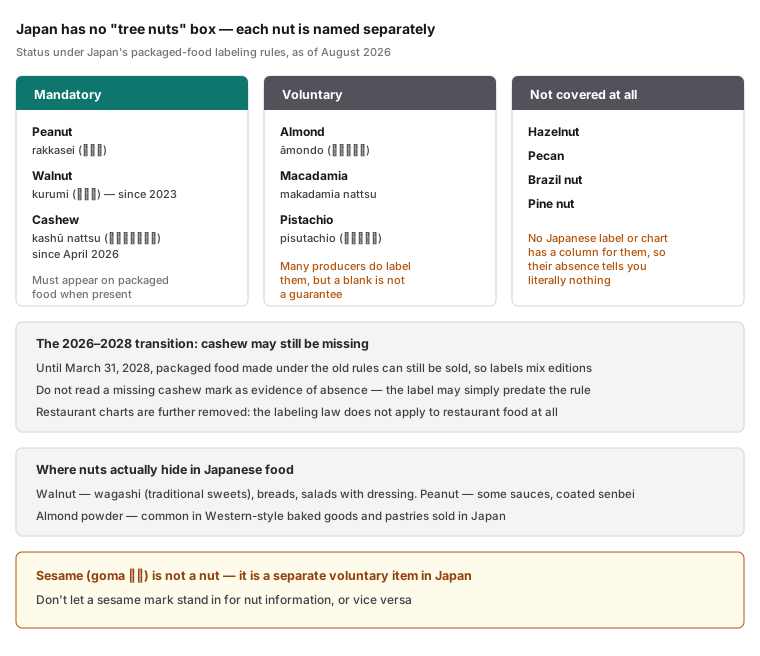
Here is where each nut stands under Japan's packaged-food labeling rules as of August 2026:
| Nut | Japanese | Status |
|---|---|---|
| Peanut | rakkasei (落花生) or pīnattsu (ピーナッツ) | Mandatory |
| Walnut | kurumi (くるみ) | Mandatory (since 2023) |
| Cashew | kashū nattsu (カシューナッツ) | Mandatory (since April 2026) |
| Almond | āmondo (アーモンド) | Voluntary |
| Macadamia | makadamia nattsu (マカダミアナッツ) | Voluntary |
| Pistachio | pisutachio (ピスタチオ) | Voluntary |
| Hazelnut, pecan, Brazil nut, pine nut | — | Not covered |
Three consequences follow. First, only peanut, walnut and cashew must appear on packaged food when present. Second, almond, macadamia and pistachio are voluntary: many producers do label them, but a blank is not a guarantee. Third — and easiest to miss — hazelnut, pecan, Brazil nut and pine nut are not on the list at all. No Japanese label or allergen chart has a column for them, so their absence tells you literally nothing. For the full comparison with EU and US lists, see Japan's list vs. the US and EU lists.
Why walnut and cashew were promoted
The changes track a real shift in Japan. In the Consumer Affairs Agency's latest nationwide survey of immediate-type food allergy (September 2024, analyzing 6,033 cases from 2023), tree nuts as a group caused 24.6% of cases — second only to hen's egg. Walnut alone accounted for 15.2%, more than cow's milk, roughly double its share in the previous survey; cashew rose to 4.6%. Peanut, counted separately in Japan, was 7.0%. That surge is why walnut became mandatory in 2023 and cashew in April 2026.
The 2026–2028 transition: cashew may still be missing
Cashew's promotion comes with a grace period. Until March 31, 2028, packaged food made under the old rules can still be sold, so labels and charts you see today mix editions that treat cashew as voluntary or as mandatory. During the transition, do not read a missing cashew mark as evidence of absence — the label may simply predate the rule.
Restaurant and chain allergen charts are a step further removed: the labeling law does not apply to restaurant food at all, so every chart is voluntary and each chain chooses which items to cover. How to decode them is covered in reading Japanese allergen charts.
Where nuts actually hide in Japanese food
- Walnut appears in wagashi (traditional sweets), breads, and salads with dressing — not only in visibly nutty products.
- Peanut turns up in some sauces and coated senbei (rice crackers); check dipping sauces and snack mixes.
- Almond powder is common in Western-style baked goods and pastries sold in Japan.
- Sesame (goma ごま) is not a nut — it is a separate voluntary item in Japan. Don't let a sesame mark stand in for nut information, or vice versa.
More cross-dish surprises are in hidden allergens in Japanese cuisine.
Searching chain data with a tree-nut habit
On this site's chain search, if you select the tree-nuts category from a US/EU-style list, it maps onto Japan's individually named columns: walnut, almond, cashew, macadamia and pistachio — and nothing else, because Japanese charts carry no data for hazelnut, pecan, Brazil nut or pine nut. Those you must ask about in person, every time. How the jurisdictions map is detailed in the data guide. If you carry emergency medication, plan that side with your doctor before you fly — see emergencies in Japan for the numbers and phrases.
References
- Consumer Affairs Agency of Japan, information page on food allergen labelling (in Japanese)
- Consumer Affairs Agency of Japan, Food Allergen Labelling Handbook, April 2026 edition (in Japanese)
- Consumer Affairs Agency of Japan, FY2024 report on the nationwide survey of immediate-type food allergy, September 2024 (in Japanese)
This article is for general information purposes and is not medical advice. While we strive for accuracy, regulations and company disclosures may change. Always check the latest official information from the restaurant before eating.