Tools and Apps for Managing Food Allergies in Japan
Published: 2026-08-01 ・ Last updated: 2026-08-18
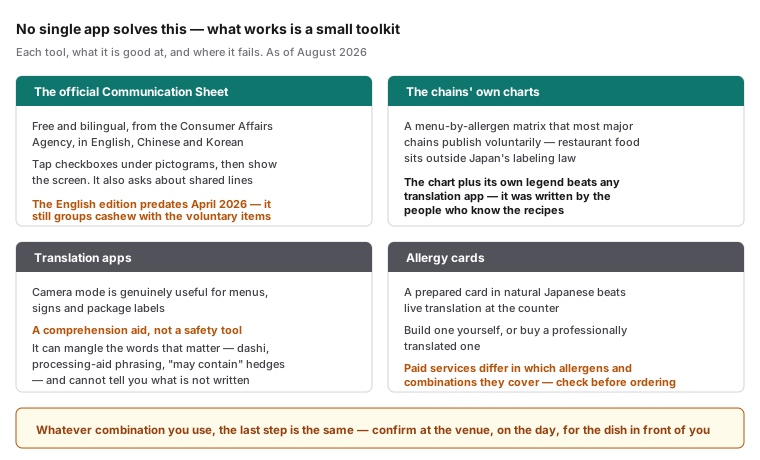
No single app solves food allergies in Japan. What works is a small toolkit: one official document, the chains' own published charts, a translation app used with care, and a card you can hand over. Here is each tool, what it is good at, and where it fails — as of August 2026.
The official one: the CAA Food Allergy Communication Sheet
Japan's Consumer Affairs Agency (Shōhishachō 消費者庁) publishes a free, bilingual Food Allergy Communication Sheet, downloadable from its English food-labelling page in English, Chinese, and Korean editions. It is built for smartphones: you tap checkboxes under pictograms of your allergens, then show the screen to staff. The English edition opens with "I have food allergies" in both languages, asks "Does this food contain any of the allergens marked below?", and adds a follow-up question about shared production lines — a real risk that casual conversation rarely reaches.
One caveat: the current English edition predates the April 2026 rule change, so it groups cashew nut with the 20 recommended items rather than the now 9 mandatory ones. The pictogram is still there and still works — just do not read the grouping as current law. Download the PDF before your trip; the checkboxes need a proper PDF viewer.
The chains' own charts
For chain restaurants, the deepest information is the chain's own allergen chart (arerugen ichiranhyō アレルゲン一覧表): a menu-by-allergen matrix most major chains publish voluntarily, since restaurant food sits outside Japan's labeling law. Symbols and coverage differ per chain, so read our guide to reading Japanese allergen charts before trusting one. As a rule, the chart plus its own legend beats any translation app, because it was written by the people who know the recipes.
Translation apps, used carefully
A camera-translation app such as Google Translate's camera mode is genuinely useful for menus, signs, and package labels: point the camera at Japanese text and read the overlay. Treat it as a comprehension aid, not a safety tool. Machine translation can mangle exactly the words that matter — dashi, processing-aid phrasing, "may contain" hedges — and it cannot tell you what is not written. For allergy-critical reading, the fixed vocabulary of allergen charts and pictograms is more reliable than free-text translation: the kanji for the regulated allergens (wheat 小麦, buckwheat 蕎麦/そば, egg 卵, milk 乳) are short, standardized, and worth learning to recognize directly.
Allergy cards
A prepared card in natural Japanese beats live translation at the counter. You can build one yourself from our allergy card phrases, or buy a professionally translated one: Equal Eats, for example, sells dietary translation cards in Japanese among 58 languages, in plastic and instant-PDF formats, and advertises human translation with native-speaker review (as of August 2026). Paid card services differ in which allergens and combinations they cover, so check yours is available before ordering.
Where this site fits
Our chain search is one more tool in the kit: it collects menu-level allergen information for Japanese chains, based on the chains' own published charts, and lets you view it against your home region's allergen list — see which standards you can pick. Its scope is honest and limited: chains, not independent restaurants; published data, not kitchens. Whatever combination of tools you use, the last step is always the same — confirm at the venue, on the day, for the dish in front of you.
References
This article is for general information purposes and is not medical advice. While we strive for accuracy, regulations and company disclosures may change. Always check the latest official information from the restaurant before eating.